 Editor’s Note: In her review of 2013, Board President Milbrey “Mibs” Zelley reports to you on our progress during the past year and our plans for this coming year. We are grateful for her guidance and enthusiasm which have helped us achieve so much, especially this past year.
Dear Friends,
When I sat down to write the 2013 Year in Review for Friends of Taconic State Park, I was astounded to realize what a full and busy year it had been for us. Thanks to you, our contributing members, we were able to offer at least one event every month (sometimes two) and we completed two major preservation projects at the historic Copake Iron Works. We completed the urgent task of stabilizing the four exterior arches and the inner kiln of the centerpiece blast furnace as well as the re-pointing of the brickwork on the Iron Works machine shop. We opened a new trail, participated in several community events, and increased our membership a hundred-fold!

We started the new year on the right (and left) foot with our second annual First Day Hike. Chris Rickard, our new Taconic State Park manager, led 25 hikers on a brisk walk (it was cold!) to Bash Bish Falls, and afterward everyone gathered around a roaring bonfire for hot chocolate and snacks.

February's offering was our annual President’s Day “Snow or No” hike to Sunset Rock where several of us enjoyed the special tranquility of the winter woods with their open vistas. Join us this year on February 16th for a “Snow or No” hike on the new section of the Harlem Valley Rail Trail.

In March, we hosted our third annual “Welcome Spring” benefit event, organized by “Friend-Extraordinaire” Margaret Roach, and featuring Ken Greene of the Hudson Valley Seed Library. A capacity crowd turned out at the Copake Grange to hear Ken’s fascinating talk on heirloom gardening and to shop at our gardeners’ market featuring local organic seed purveyors.
 We are deeply grateful for Margaret’s generosity of time, treasure and talent, not just in organizing this event, but in her beneficence throughout the year. Mark your calendars now for our fourth Welcome Spring event on Saturday, March 22nd – details to follow.
April saw the realization of a long-dreamed of trail opening. Our “get it done gang” of Edgar Masters, Chris Rickard (not pictured), Bob Callahan, Jim Conklin, Tom Flaherty and Steve Near built a trail connecting the Copake Iron Works to the Bash Bish Falls.

It is a magnificent new pathway running above the southern bank of the Bash Bish Brook, past the facsimile of a charcoal hearth and the “Day Pond.” We have dubbed this new trail the Iron Works to Bash Bish Connector and it has succeeded in introducing the Copake Iron Works to many new visitors.

Also in April, our Board vice president Brian Boom hosted a lecture at the Roeliff Jansen Historical Society. Brian, a scholar in residence at the New York Botanical Garden, gave a fascinating talk on environmental challenges in Cuba where he travels frequently on scientific expeditions. His deep knowledge of the flora and fauna of Cuba brought a new dimension to our understanding of global environmental issues.

May was a busy month. About 50 park lovers participated in the first “I Love My Park Day,” a state-wide event sponsored by Parks and Trails New York. With an abundance of enthusiastic volunteers, we blazed our new trail, weed-whacked a path down to Bash Bish Brook for summertime use in stream ecology programs, cleaned up the camp grounds, and refurbished the garden around the “Business Office” at the Copake Iron Works. We were honored to welcome New York State Assemblymember Didi Barrett who kicked off the festivities.
 The following weekend, our good friend Margaret Roach brought us Lee Reich, “the PhD of Fruit” who spoke on Organic Backyard Fruit Growing, and led a hands-on workshops on fruit grafting. Margaret also opened her Copake Falls garden to the public that day, bringing people from far and wide, eager to see her incredible garden. The considerable proceeds of the day’s events greatly benefited our Furnace Stabilization Fund. Lee returns on May 10th for a talk on Weed Less Gardening.
In June, world-renowned botanist Robert Naczi of the New York Botanical Garden, led a fascinating walk to the top of Sunset Rock Road. We discovered a multitude of different ferns and he pointed out quite a few different species of mountain blueberry bushes. Using botanical lenses, we were able to see the microscopic beauty of so many flowers, leaves, and plants.

We are grateful to Dr. Naczi for giving us the benefit of his wisdom, and to board member Brian Boom (pictured above) for arranging this fascinating visit from his NYBG colleague.
 Also in June, Friends of Taconic State Park was vicariously honored when Parks & Trails New York awarded the Volunteer Service Award to Edgar Masters for his work to preserve the Copake Iron Works. Pictured here is Edgar receiving the award from Laura DiBetta, our good friend at Parks & Trails New York.
The arrival of the summer camping season in mid-June brought many new visitors to the park. Board member Jim Mackin organized three feature film nights at the Copake Iron Works complete with his unique collection of fun and funny short films on Park-related topics. And what film would you choose to kickoff Movie Night at the Iron Works? “Iron Man” of course! Kids waved glo-sticks and ate popcorn while the mosquitoes kept their distance!
 From July through November, we hosted “The Black Art -- Charcoaling on Mount Washington,” produced by the Mount Washington (MA) History Project. Mounted in the Copake Ironworks machine shop, the fascinating exhibit attracted a steady flow of visitors all summer and well into the fall.

The exhibit was formally opened at our fifth Annual Meeting and Potluck Supper when Cory Hines and Mary King Austin, curators of the exhibit, spoke to a standing room only crowd about the genesis and production of the exhibit. Also at the Annual Meeting we proclaimed the date to be Victor Rolando Day in honor of the man who has served as de facto Guardian of the Iron Works since the 1950s.
 In August, on Copake Falls Day, our loyal supporter Margaret Roach hosted a sold-out benefit lecture by the Fabulous Beekman Boys. Their enthralling talk was a heartfelt and heartwarming memoir of the couple’s successful efforts to help revive a moribund farming community.
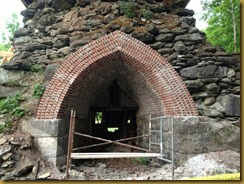 Most exciting of all the summer's events, though, was the preservation work being done at the Iron Works. After having completed the protective cover for the historic blast furnace, we set about the important task of stabilizing the structure’s four exterior arches and its interior kiln. This painstaking work required the special expertise of Ganem Masonry, specialists in historic masonry preservation. Week by week, we watched in amazement as Ziggy and his team from Ganem stabilized each of the four arches and the interior kiln. Now, visitors to the site really get a sense of the immensity of the structure, and can more readily visualize what it looked like in it hey-day in the 19th century.
 Meanwhile, just across the way from the furnace, we pondered what to do about the crumbling brickwork of the foundation and facades of the Iron Works machine shop. Our prayers were answered when we learned that an anonymous benefactor had funded the cost of engaging Ganem Masonry to carry out that stabilization work as well.
Today, the two central structures of the Copake Iron Works stand ready to tell their story of this important 19th century industrial site.
Although the pace of life in Copake Falls slows down a bit with the return of autumn, our schedule did not! In September, we offered a special hike as part of the 2nd Annual Hudson Valley Ramble. Founding Board president and veteran hiker Jane Peck led a group on this beautiful fall ramble through a part of our landscape rarely enjoyed by the public.
 In October, Board member Jim Mackin hosted “Art in the Park,” a lively talk about the many artists, both past and present, who have created enduring images of our park. Jim’s witty and wise slideshow highlighting famous Taconic artists gave us a new appreciation of the beauty of our Park, seen through the eyes of the artists. Mark your calendar now for Jim’s June 21st talk on the history of the Copake Iron Works – details to follow.
Board members Robin Bruce and Deb Cohen—our hostesses with the mostesses -- organized Furnace Fest in November which, despite terrible weather, drew a large crowd to witness the “unveiling” of the stabilized furnace arches. We were honored at that event by a surprise visit from Wint Aldrich, the former New York State Deputy Commissioner of Historic Preservation who has been a loyal supporter since helping us launch our preservation efforts in 2010.

We ended the year doing what we seem to do best – celebrating the Copake Iron Works. Thanks once again to the organizing magic of Robin and Deb, more than 100 visitors enjoyed hot dogs, hamburgers and baked ziti during Winter Walk 2013, an annual holiday celebration in Copake Falls.
We are grateful to many generous contributors for making our work possible including New York State Parks Champion Lucy R. Waletzky, Edgar Masters, Margaret Roach and most recently, The William G. Pomeroy Foundation.
 Making the acquaintance a year or so ago of several descendants of the Pomeroy family (the founders of the Copake Iron Works), was among the most exciting links we have discovered in pursuit of our history. Many of us involved with the preservation of the Copake Iron Works feel a special connection to the 19th century Pomeroys, having spent so much time in the place they created. The Pomeroy Foundation’s magnificent grant to our Furnace Stabilization Project encourages us in our passion to preserve this special place in history.
We close by thanking YOU, our loyal membership whose support makes it possible for us to continue to fulfill our mission: To support the activities – cultural, recreational, and historic – of Taconic State Park.
To learn more about our work, including our schedule of events for 2014, visit us on Facebook or at www.FriendsofTSP.org.
With deepest gratitude,
Mibs Zelley, President


